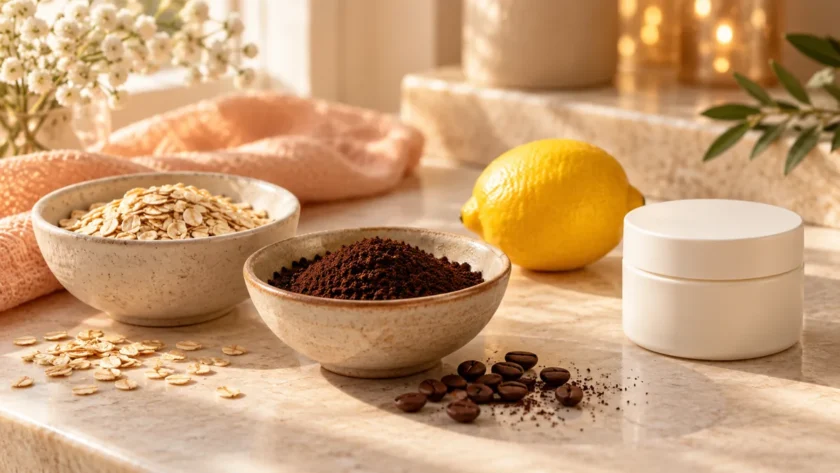
Homemade face scrubs often sound appealing because the ingredients are familiar and inexpensive. But food ingredients are not automatically suitable for facial skin. This guide looks at three popular combinations—coffee and honey, oats and honey, and lemon and sugar—and explains why a simpler skincare routine may be a better choice.
Safety update: This article previously included recipes for facial scrubs. Those instructions have been removed because gritty particles can irritate skin and citrus juice can cause reactions, including reactions after sunlight exposure. The guidance below replaces the earlier recipes.
1. Coffee and honey: a familiar mixture with uncertain benefits
Coffee grounds vary in size and texture. Rubbing them on the face is mechanical exfoliation, which can be too irritating for dry, sensitive or acne-prone skin. The presence of caffeine or antioxidants in coffee does not establish that a homemade scrub will brighten skin or treat puffiness. Honey does not make an abrasive mixture suitable for every skin type.
This combination is not recommended here as a facial treatment. If your goal is to remove makeup, sunscreen or everyday dirt, start with a gentle cleanser rather than adding kitchen particles. See the basic skincare routine guide for the main steps.
2. Oats and honey: kitchen oats are not a formulated oatmeal product
Colloidal oatmeal is used in some skincare products for its soothing properties. That does not mean a homemade mixture of ordinary oats and honey has been tested for the same purpose. Its texture, concentration and cleanliness are different, and people can react to either ingredient.
For dry or easily irritated skin, consider a fragrance-free moisturizer or a formulated product containing colloidal oatmeal, provided you tolerate its ingredients. Follow the label. Avoid oat-containing products if you have an oat allergy. An irritated face needs a pause from experiments, rather than a new scrub.
3. Lemon and sugar: leave this combination off your face
Lemon juice is not a substitute for a formulated vitamin C skincare product. Citrus contact followed by sunlight can cause phytophotodermatitis, a reaction that may lead to redness, blistering or lasting discoloration. Sugar adds friction. Avoid applying this mixture to facial skin, including dark marks or clogged pores.
A home patch test cannot rule out a reaction that depends on sunlight exposure. Do not try to make lemon juice safer by diluting it or adding moisturizer. If a mixture causes burning, wash it off and stop using it. Seek medical advice for significant pain, swelling, blistering or persistent symptoms.
A simpler approach to smoother-feeling skin
Begin with gentle cleansing, moisturizing and sun protection. Exfoliation is an optional step. If you choose to exfoliate, match the method to your skin and follow product instructions. Avoid exfoliating sunburned, broken or irritated skin. Retinoids and some acne treatments can already make skin more sensitive, so check with a pharmacist or dermatologist before adding another exfoliant.
There is no once-or-twice-weekly schedule that suits everyone. Start cautiously and stop if you notice stinging, redness, tightness or peeling. Do not scrub harder to chase a visible glow. For skin-type basics, read how to identify your skin type.
Storage and hygiene
This article does not recommend storing homemade skincare mixtures. A clean jar and refrigeration do not establish a safe shelf life for an unpreserved preparation. Do not rely on its smell or appearance to prove it is safe. Ready-made products provide ingredient labels and storage instructions that kitchen recipes lack.
Sources and further reading
American Academy of Dermatology: How to safely exfoliate at home
American Academy of Dermatology: Facial masks and skin care
DermNet: Phytophotodermatitis
Written by KGlow Writer. This is an educational summary, not individualized medical advice. I am not a dermatologist. Last reviewed: October 9, 2026.